Brand Bidding
CPC Inflated by Brand Bidding: How to Protect Your Cost Per Click and Recover Customers in 2026
Branddi · Published on
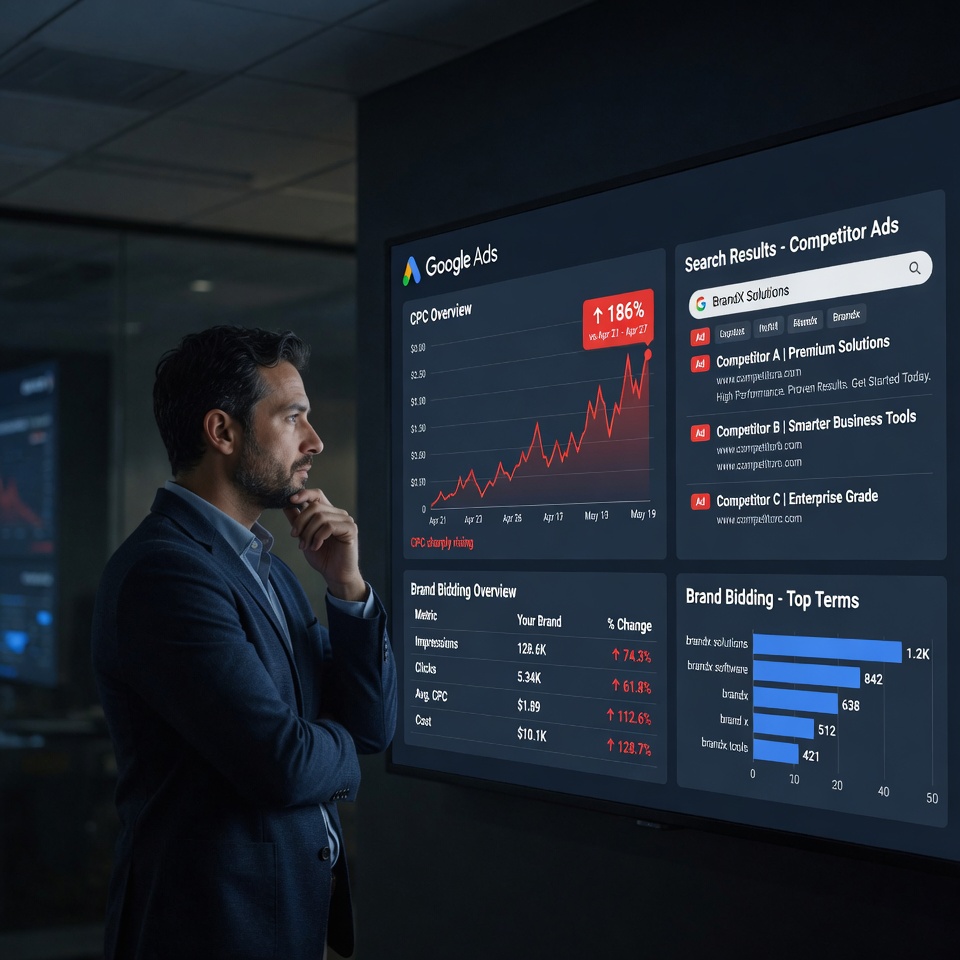
In the Brazilian tourism sector, between December 2025 and February 2026, 59,593 occurrences of improper use of brands in ads were recorded — with 97% directly linked to brand bidding. This means more than 660 attacks per day inflating the CPC of brands that invest heavily in paid media. If your cost per click has risen in recent months without apparent explanation, the cause may not be in your campaigns, but in competitors who are buying your brand name on Google Ads. In this article, you'll understand exactly how this works, the real impact on your budget, and how to reverse the situation.
What is CPC and how brand bidding inflates the cost per click
CPC — cost per click — is the amount you pay every time someone clicks on your ad. On Google Ads, this value is defined by an auction system: the more advertisers dispute the same keyword, the higher the cost per click. In terms of brand, CPC should naturally be low, because competition for branded keywords tends to be minimal.
Brand bidding breaks this logic. When competitors, unauthorized affiliates, or opportunistic sellers buy your brand name as a keyword, they enter the auction and force CPC up artificially. You start paying more to appear in searches that should be exclusively yours. The result is an inflated cost per click that erodes the ROI of the entire media operation.
Why brand CPC is rising in 2026: real market data
The growth of brand bidding in Brazil is not a perception — it's a documented trend. Branddi data shows that, in the tourism sector alone, the daily average of improper brand use occurrences exceeds 660 cases. In April 2026, brand CPC rose on average 31% across various sectors, with even higher peaks in highly competitive segments like retail, beauty, and technology.
Factors accelerating this cost per click inflation include:
- AI automation — artificial intelligence tools allow creating hundreds of ad variations automatically, scaling brand bidding industrially.
- More players in the auction — beyond direct competitors, affiliates, price comparators, and parallel sellers dispute the same branded keywords.
- Decline of generic search — with top and middle funnel migrating to social media and AI, brand terms concentrate more and more conversions, attracting more interest from opportunists.
- More aggressive platforms — marketplaces and aggregators invest heavily in buying third-party brands to capture qualified traffic.
How brand bidding steals customers and distorts cost per click
The impact of brand bidding goes beyond CPC. When a competitor appears at the top of Google for a search of your brand, they capture clicks that should be yours — clicks from consumers who were already decided to buy from you.
This diversion generates a chain of interconnected losses:
- Inflated CPC — you pay 30% to 50% more for clicks on your own brand terms.
- Diverted traffic — between 20% and 30% of qualified traffic is captured by invading advertisers.
- Lost conversions — consumers who click on the wrong ad may convert with the competitor or abandon the journey due to confusion.
- Distorted ROI — the inflated cost per click compromises the ROAS of entire campaigns, leading marketing teams to make decisions based on contaminated data.
- Wasted budget — a significant part of the media budget is spent just to defend a position that should be organic and cheap.
In practice, the brand pays twice: once for the branding investment that generated demand, and again for the inflated cost per click to recover the traffic being stolen.
How to identify if brand bidding is inflating your CPC
Before acting, it's necessary to diagnose the problem precisely. These are the clearest signs that your CPC is being inflated by brand bidding:
- Sudden increase in cost per click of branded keywords without you having changed bids or campaigns.
- Drop in CTR of brand ads — when other advertisers appear in the same auction, your CTR decreases naturally.
- Reduced impression share — if your brand is not appearing in 100% of searches for its own name, someone is disputing that space.
- Competitor ads visible when searching for your brand on Google — test regularly in incognito window.
- Increase in total cost of brand campaigns without proportional growth in conversions or revenue.
Tools like the Google Ads auction report, combined with specialized monitoring platforms, allow identifying exactly who is buying your keywords and how frequently.
Strategies to reduce CPC and combat brand bidding
Reducing inflated cost per click requires a multi-layered approach:
Continuous monitoring of branded keywords
Implement tools that track in real time who is advertising with your brand name. Monitoring needs to be daily and automated — brand bidding attacks are dynamic and change constantly.
Agile notification and removal
When identifying infringers, send immediate extrajudicial notifications. Google has a registered trademark complaint form that restricts the use of the name in ad text. For persistent cases, legal actions already have favorable jurisprudence in Brazil.
Defensive campaign optimization
Maintain brand campaigns with competitive bids and complete extensions (sitelinks, callouts, snippets). The more space your ad occupies on the results page, the less visibility remains for invaders and the smaller the impact on your CPC.
Integration of protection data with media
Cross brand bidding monitoring data with Google Ads reports. This allows correlating cost per click spikes with the entry of new infringers into the auction — and measuring the real financial impact of each protection action.
Common mistakes that keep your CPC high and your customers vulnerable
Even companies with sophisticated marketing teams make mistakes that perpetuate the problem:
- Accepting high CPC as "market normal" — many managers attribute cost per click increase to general competitiveness without investigating if brand bidding is the real cause.
- Not monitoring brand terms — brand campaigns are usually set up and forgotten, without frequent auction monitoring.
- Reacting only sporadically — removing an infringer without continuous monitoring is ineffective. New invaders appear in days or hours.
- Isolating brand protection from the media team — when protection and performance don't talk, CPC remains high and no one connects the causes.
Conclusion
Brand bidding is one of the biggest silent threats to digital media budget in 2026. It inflates CPC, diverts qualified customers, and distorts ROI of entire campaigns — all exploiting the name your brand built over years of investment. The good news is that, with continuous monitoring, agile removal, and integration between protection and media, companies are already able to reduce brand cost per click by 25% to 40% and recover significant traffic.
Want to find out if brand bidding is inflating your brand's CPC and stealing your customers? Contact the Branddi team right now via our contact page and request a free Brand Bidding Protection diagnosis — we transform protection into real cost reduction and revenue recovery.
I want my Branddi diagnosis →
Related articles
-
Competitors advertise on my brand: who should I hire?
Learn who to hire for brand bidding monitoring, what evidence to request and how to assign responsibilities across media, legal and brand protection.
-
From AI Recommendations to Google: The New Brand Bidding Risk
Discovery is moving to AI, but validation still happens on Google. Learn why defending branded terms and measuring AI Search now belong to one operation.
-
Google Ads Trademarks: What They Actually Restrict
Learn what Google Ads trademark policy restricts, what remains permitted, and how to prepare a complaint without confusing trademarks with brand bidding.
-
How to find who advertises on your brand name
Identify ads appearing on searches for your brand. Use an evidence template, check the advertiser and understand the limits of keyword inference.
-
What brand bidding is and why it raises your brand CPC
Brand bidding means buying your brand name as a keyword. See the auction mechanism that raises your CPC, what Google allows and what Brazilian courts ruled.