Black Friday digital scams: fake websites, ads and profiles
Build a plan against cloned sites, phishing, fake ads, profiles and support channels that misuse your brand on Black Friday.
Black Friday scams combine urgency, discounts and copied brand assets to move shoppers into fake websites, profiles or support channels. Brands need early detection, complete evidence and coordinated security, customer-care, communications and takedown workflows to reduce harm and recurrence.
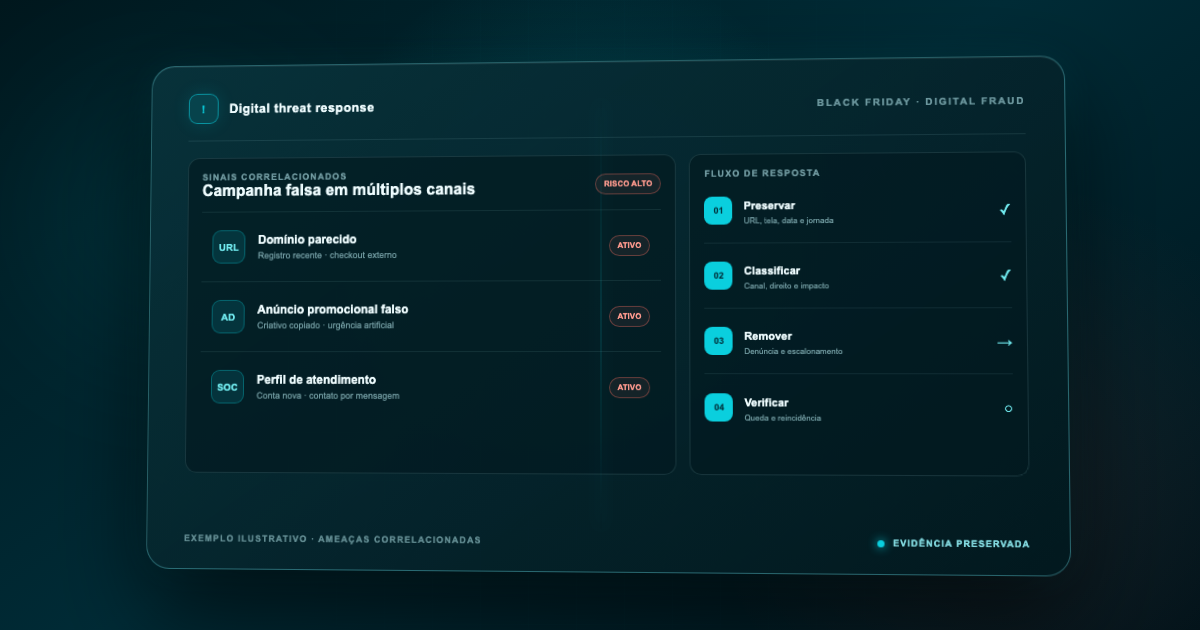
registration and infrastructure
message and destination
victim reports become signals
Which scams misuse brands on Black Friday?
Formats change, but the pattern repeats: copy trust signals, create urgency and move the shopper to a channel controlled by the scammer. Coverage should include cloned sites, typosquatting, phishing, fake ads, profiles, coupons, support channels and apps.
- look-alike or promotional domains;
- copied creatives leading to false checkout or payment;
- profiles offering coupons, giveaways or support;
- messages requesting credentials, personal data or urgent payment;
- the same scam republished through new infrastructure.
What should be ready before November?
Inventory official domains, profiles, phone numbers, apps, ad accounts and campaigns. Document legitimate promotions, payment methods and partners so teams can reduce false positives and guide consumers.
Configure monitoring for the brand, misspellings, priority products and terms such as promotion, coupon, outlet, official and Black Friday.
Which evidence should be preserved?
Capture the occurrence before engaging the operator. Record the full URL, date, time, country, device, account or ad identifier, creative, destination, payment method and copied asset.
| Channel | Minimum evidence | First action |
|---|---|---|
| Domain | WHOIS, DNS, page and URL | Identify registrar and hosting |
| Social profile | Profile, posts and identifiers | Use impersonation or IP flow |
| Ad | Placement, advertiser, creative and destination | Preserve the full journey |
| Customer care | Report, link, receipt and channel | Connect it to the incident |
How should a threat be handled?
Use six steps: preserve, classify, contain, report, verify and monitor recurrence. A submitted form is not a result. Confirm the asset is unavailable in the observed territory and look for new domains, accounts and creatives.
When victims are involved, align customer care and communications around official channels and accepted payment methods without amplifying malicious links.
Which metrics matter?
Measure detection, documentation and decision time; verified-removal rate; critical threats still active; recurrence by domain, account and creative; and affected consumers or customer-care demand.
Sources
Continue through the Black Friday protection plan
-
Black Friday 2026: brand protection guide
Prepare your brand for Black Friday 2026 with an integrated plan for brand bidding, digital scams, counterfeiting and unauthorized sellers.
-
Brand bidding on Black Friday: protect your branded terms
Learn how to monitor competitors, affiliates and ads on branded terms during Black Friday while distinguishing legitimate competition from misuse.
-
Buy Box on Black Friday: protect sales and margin
Learn how to monitor sellers, prices, stock and offers competing for the Buy Box during Black Friday without treating every commercial dispute as a violation.
-
Black Friday counterfeiting: fake goods and suspicious sellers
Distinguish counterfeit goods, unauthorized sellers and channel diversion, preserve evidence and protect consumers and the Buy Box.
Remove digital scams that use your brand to deceive shoppers
Monitor domains, pages, ads, profiles and false channels with organized evidence.
Frequently asked questions
How can a fake Black Friday website be identified?
Compare the domain, certificate, official channels, payment methods, brand assets and offer conditions. Brands should also document infrastructure and the ad journey.
What should happen after a consumer reports a scam?
Preserve the report and links, guide the person to official channels, connect the case to monitoring and activate the appropriate response teams.
Does reporting a fake profile solve the problem?
It is one step. Removal must be verified and republication monitored across new accounts, domains and creatives.
When should domain monitoring begin?
Establish a baseline in August or September and increase monitoring frequency as campaigns and offers grow.