Black Friday counterfeiting: fake goods and suspicious sellers
Distinguish counterfeit goods, unauthorized sellers and channel diversion, preserve evidence and protect consumers and the Buy Box.
On Black Friday, low prices and a surge in sellers may conceal counterfeit goods, diverted distribution or unauthorized brand use. The response starts with correct classification: not every unauthorized offer is fake, and each hypothesis requires different evidence, documents and action channels.
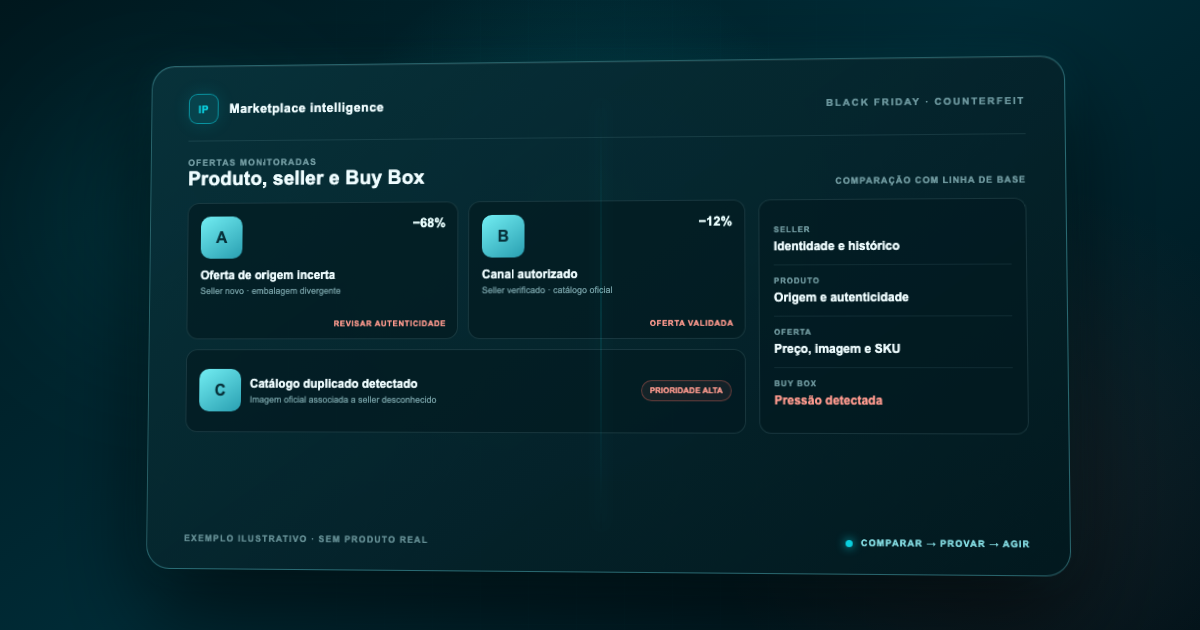
origin, package and authenticity
price, images, copy and SKU
identity, history and recurrence
How are counterfeit goods different from unauthorized sellers?
A counterfeit imitates the trademark, package or product without authorization. An unauthorized seller may offer genuine goods outside commercial policy. Gray-market trade, channel diversion, unauthorized images, pricing breaches and modified catalog data are separate issues.
Calling every case counterfeiting weakens reports. Authenticity, authorization and offer conduct must be assessed separately.
What should be monitored in marketplaces?
Create a baseline of authorized sellers, SKUs, EANs, images, descriptions, packaging, prices and promotional policy. Watch new sellers, abrupt price changes, Buy Box loss, duplicate listings and reviews suggesting a different product.
- prices inconsistent with stated origin or condition;
- official imagery paired with different packaging;
- new or inconsistent seller identities;
- missing disclosure of refurbishment, import or warranty;
- the same listing returning after removal.
Which evidence supports action?
Record the offer URL, seller, SKU or ID, date, price, images, description, reviews and Buy Box position. Compare it with official products and assets. A test purchase and chain of custody may be necessary when the physical item determines authenticity.
Trademark documents, representative authorization and a specific violated rule reduce rejection.
| Situation | Core evidence | Initial response |
|---|---|---|
| Possible counterfeit | Technical comparison and rights | Preserve and assess authenticity |
| Unauthorized seller | Policy and commercial origin | Investigate distribution |
| Unauthorized image or mark | Original asset and reproduction | Assess IP reporting channel |
| Price and Buy Box pressure | Offer and seller history | Use channel governance |
How should occurrences be prioritized?
Prioritize consumer harm, estimated volume, offer position, Buy Box control, recurrence and propagation. Health and safety products require a different response from an offer with no known sales.
Which metrics show channel control?
Track new and recurring sellers, active critical offers, official-store Buy Box share, time to decision, verified removals, republication and concentration by source. Claim recovered revenue only with a defined attribution method.
Sources
Continue through the Black Friday protection plan
-
Black Friday 2026: brand protection guide
Prepare your brand for Black Friday 2026 with an integrated plan for brand bidding, digital scams, counterfeiting and unauthorized sellers.
-
Brand bidding on Black Friday: protect your branded terms
Learn how to monitor competitors, affiliates and ads on branded terms during Black Friday while distinguishing legitimate competition from misuse.
-
Black Friday digital scams: fake websites, ads and profiles
Build a plan against cloned sites, phishing, fake ads, profiles and support channels that misuse your brand on Black Friday.
-
Buy Box on Black Friday: protect sales and margin
Learn how to monitor sellers, prices, stock and offers competing for the Buy Box during Black Friday without treating every commercial dispute as a violation.
Remove counterfeit goods from marketplaces and protect your revenue
Map sellers, offers and counterfeit signals before seasonal volume increases.
Frequently asked questions
Does every unauthorized seller offer fake goods?
No. Genuine products can be sold outside commercial policy. Authenticity, origin, authorization and offer conduct require separate assessment.
Does a very low price prove counterfeiting?
No. It is an investigation signal. Compare origin, description, imagery, packaging, seller history and, when necessary, the physical product.
What should be captured before reporting an offer?
URL, seller, product ID or SKU, date, price, images, description, reviews, Buy Box position and the brand's supporting documents.
Does removing one offer close the case?
Not always. Monitor republishing, related accounts and recurrence to determine whether it is isolated or part of a network.