AI Search
How to Measure Traffic from ChatGPT, Gemini, and Perplexity in GA4
Branddi · Published on
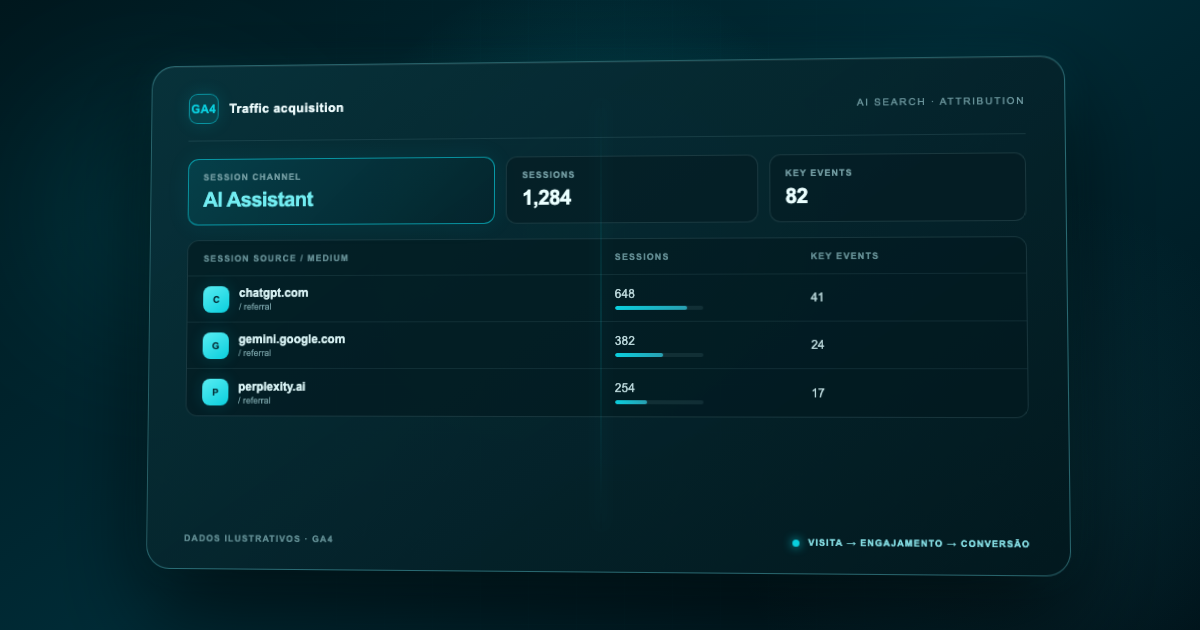
To measure traffic from ChatGPT, Gemini, and Perplexity in GA4, open Reports > Acquisition > Traffic acquisition, select Session default channel group, and filter for AI Assistant. Then use Session source / medium to separate platforms and compare sessions, engagement, key events, and revenue. GA4 measures visits, not how often an AI mentioned your brand.
What does GA4 measure about AI traffic?
GA4 records a session when someone clicks a link in an assistant and reaches your site with recognizable source information. It can show the source, landing page, engagement, form submissions, registrations, purchases, and other configured events.
It does not reveal the user's prompt, full AI answer, citation impressions without clicks, or your brand's position in the response. AI Visibility measures presence and recommendation; GA4 measures the behavior of visitors who reached the site. Pair this report with AI Visibility measurement.
Where can you find AI-assistant traffic in GA4?
- Open the correct Analytics property.
- Go to Reports > Acquisition > Traffic acquisition.
- Select Session default channel group.
- Search or filter for AI Assistant.
- Add Session source / medium as a secondary dimension.
- Compare a consistent date range with the previous period.
The Traffic acquisition report covers sessions from new and returning users. Its dimensions carry the “Session” prefix because they describe that visit rather than necessarily the user's first interaction. Official documentation: https://support.google.com/analytics/answer/12923437, accessed September 3, 2026.
Does GA4 have an AI Assistant channel?
Yes. Google's current default-channel documentation includes AI Assistant for traffic from sources such as ChatGPT, Gemini, DeepSeek, Copilot, and Grok. However, Google explicitly excludes AI Overviews and AI Mode from that channel. Their clicks are classified as Organic Search.
- Visit origin — Expected default channel — Interpretation
- Recognized assistants — AI Assistant — Click from an assistant interface
- Google AI Overviews and AI Mode — Organic Search — Included in Google organic traffic under the current rule
- Source information missing — Direct / None — GA4 cannot attribute it safely
See https://support.google.com/analytics/answer/9756891, accessed September 3, 2026. Channel definitions can evolve, so record the analysis date and verify the values in your property.
How do you separate ChatGPT, Gemini, and Perplexity?
After filtering AI Assistant, use Session source / medium. Values may appear as chatgpt.com / referral, gemini.google.com / referral, and perplexity.ai / referral. These are examples, not a permanent taxonomy. Domains, apps, and referral behavior can change.
Inventory the values actually present in your report. Preserve the raw source and normalize names only in a reporting layer such as a spreadsheet, Looker Studio, or a custom channel group. Compare sessions, engaged sessions, key events, session key-event rate, and revenue by platform.
Should you create a custom channel group?
A custom group helps when your team needs its own definition, platform families, or historical consistency. GA4 supports custom channel groups in acquisition reports, explorations, custom reports, and audience conditions, and applies their rules retroactively.
Create a channel named AI Assistants, set Source matches regex, include only domains observed in your property, and place the rule above Referral. A restricted starting expression is:
^(chatgpt\.com|chat\.openai\.com|gemini\.google\.com|perplexity\.ai)$
Test and adapt it. Overly broad expressions may capture unrelated sources. Google's own example covers ChatGPT, Gemini, Copilot, Claude, and Perplexity and advises updating the regex as URLs change: https://support.google.com/analytics/answer/13051316, accessed September 3, 2026.
Which metrics matter?
Sessions measure volume, not quality. Add:
- engaged sessions and engagement rate;
- average engagement time per session;
- key events such as forms, registrations, demos, or purchases;
- session key-event rate;
- total revenue when ecommerce is implemented correctly.
Compare AI Assistant with Organic Search and Referral. A platform may send few but highly qualified visits, or many visitors who do not advance. Interpret the numbers against the landing page's purpose.
Which pages receive AI traffic?
Add Landing page + query string, or create an exploration combining landing page, session source, and key event. Classify pages by discovery, consideration, decision, and support or risk. A page with ten sessions and two commercial requests may matter more than one with a hundred sessions and no key event.
Session source or First user source?
Use Session dimensions to analyze the visit delivered by an assistant. Use First user dimensions to identify the source that originally acquired a new user. A person may discover the brand through ChatGPT and return through Google, or first arrive through paid media and later revisit from Perplexity. The scopes answer different questions. Official explanation: https://support.google.com/analytics/answer/11080067, accessed September 3, 2026.
Why does some traffic appear as Direct / None?
(direct) / (none) means GA4 did not receive a clear source. A browser or app may omit the referrer, redirects may remove information, parameters may be lost, or blockers may interfere with measurement. Do not reassign that volume to AI based on an assumption.
Google documents missing referral information, redirects, and blockers as reasons for Direct / None: https://support.google.com/analytics/answer/15258820, accessed September 3, 2026. Check consent, tag management, redirects, domains, and implementation before declaring that AI traffic fell.
Should AI links use UTM parameters?
Use UTMs only on links your company controls, such as a proprietary AI experience, campaign, chatbot, or partner placement. You normally cannot modify organic citations generated by external assistants.
For controlled links, standardize at least utm_source, utm_medium, and utm_campaign. Google explains how these parameters populate Traffic acquisition dimensions at https://support.google.com/analytics/answer/10917952, accessed September 3, 2026. Do not use UTMs to rewrite an observed source artificially.
How do GA4 and AI Visibility work together?
Use three layers:
- Visibility: where the brand appears and how it is described.
- Click: which assistants generate identifiable sessions.
- Outcome: which sessions produce engagement, key events, and revenue.
GA4 mainly covers the last two. Maintain a stable prompt set using How to monitor your brand in ChatGPT. If the answer is inaccurate, use Is ChatGPT getting your brand wrong?.
An executive dashboard can show monthly presence across monitored prompts, AI Assistant sessions, source platforms, landing pages, key events, and attributed revenue. Do not treat identifiable traffic as the total influence of AI.
Does GA4 show the user's ChatGPT prompt?
No. It can identify the session source and on-site behavior, but it does not expose the user's prompt or conversation.
Are Gemini and Google AI Mode reported together?
Not necessarily. The current default rules place assistants such as Gemini in AI Assistant while Google AI Overviews and AI Mode fall under Organic Search.
Is a custom group required?
No, if AI Assistant already appears in your default channels. A custom group is useful for controlled platform definitions and extra detail.
Can GA4 measure all AI influence?
No. Some visits lose their referrer, and many mentions never generate clicks. Combine analytics with response and citation monitoring.
Branddi AI Visibility connects presence, sources, competitors, and answer changes so GA4 traffic becomes part of a broader evidence set.
Official sources
- https://support.google.com/analytics/answer/12923437, accessed September 3, 2026.
- https://support.google.com/analytics/answer/9756891, accessed September 3, 2026.
- https://support.google.com/analytics/answer/13051316, accessed September 3, 2026.
- https://support.google.com/analytics/answer/11080067, accessed September 3, 2026.
- https://support.google.com/analytics/answer/15258820, accessed September 3, 2026.
- https://support.google.com/analytics/answer/10917952, accessed September 3, 2026.
Related articles
-
How to Prove AI Visibility ROI to Executives
Learn how to connect the AI Visibility Index, Presence Matrix, GA4, CRM, and incremental margin to prove AI Visibility ROI without inflating results.
-
Is ChatGPT Getting Your Brand Wrong? How to Fix It
Learn how to investigate incorrect information about your company in ChatGPT, correct public sources, and track whether answers change with evidence.
-
How to monitor your brand in ChatGPT: a question set
Monitor your brand in ChatGPT with a fixed question set, a reusable record template and weekly comparisons of mentions, sources and recommendations.
-
How to compare your brand and competitors in AI answers
Compare brands in AI answers using confirmed competitors, separate signals and clear denominators. Learn how to interpret sources and order.
-
AI Visibility: how to measure and evaluate a solution
Compare AI Visibility solutions through coverage, sources, evidence, and history. Learn what to request when assessing how AI answers present your brand.