Violação de Marca
Takedown request denied: how to review and follow up
Branddi · Published on · Updated on
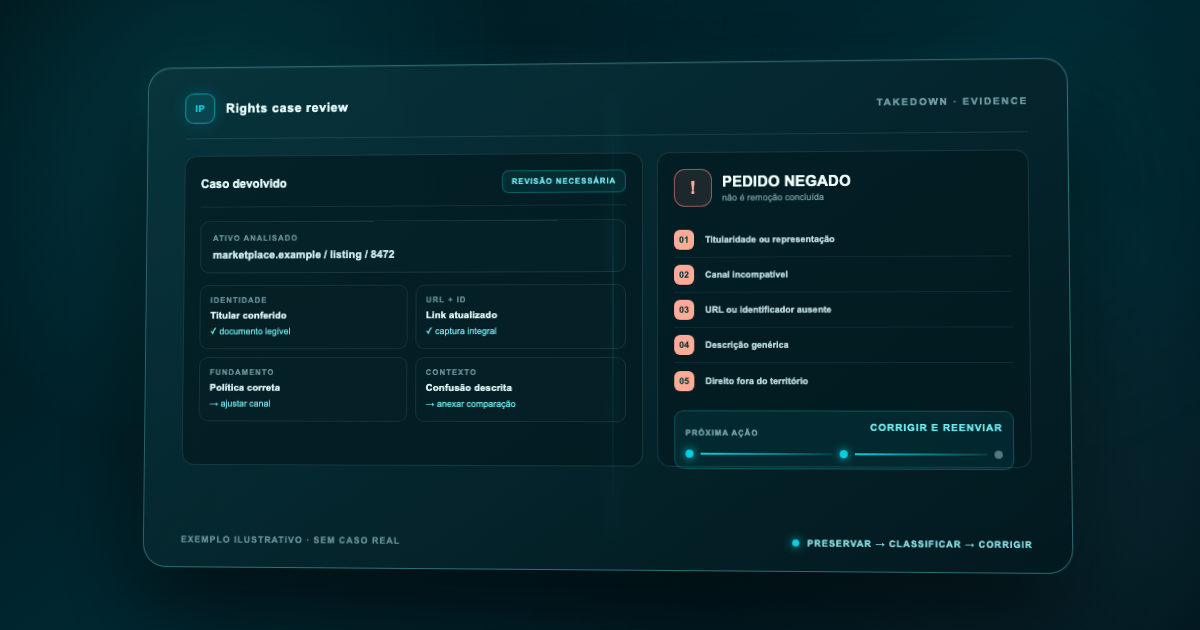
When a takedown request is denied, save the complete response, identify the stated reason and review the case before acting. Separate confirmed facts from hypotheses. Choose between adding information, appealing, filing a distinct report or closing the request, according to the channel and available evidence. Then check the outcome on the reported asset.
A rejection alone does not establish that the platform made a mistake or that documents were missing. Nor does it automatically establish that the content is allowed. Start with the response and the request actually submitted. This guide offers seven review points, without presenting them as the most frequent causes.
What should you record when the response arrives?
Save the full message, case reference, date and reporting channel. Connect the response to the exact URL or asset identifier. If one report included several links, check which received a decision and which remain unanswered. Do not extend a decision about one URL to the entire set.
Classify the response: acknowledgment, request for information, explicit rejection, referral or partial decision. An automatic acknowledgment does not establish that the substance was reviewed. If no reason is given, record “reason not provided.” Keep the team's hypothesis in a separate field, together with the evidence needed to test it.
Preserve the submitted version as well. Without it, you cannot reliably establish whether a document was missing, the address changed afterward or the response concerned different content.
1. Was the request made by an authorized representative?
Check the rights holder's name, the sender's role and the documents required by the procedure. An agency, distributor or commercial partner should not assume authority to submit every kind of claim for the brand. Request internal confirmation when the chain of representation is unclear.
Instagram's trademark form includes representation fields: https://help.instagram.com/contact/230197320740525, accessed October 21, 2026. Check the requirements of the specific channel. Do not send personal or commercial documents beyond what is necessary, and control access to the preserved material.
2. Does the channel match the product and reported problem?
Review the path taken to reach the form. Trademark, impersonation, account security and counterfeit goods are not interchangeable categories. Describe the observed conduct first, then confirm which procedure can address it. Changing a category label without changing the factual basis does not fix the case.
Google's reporting tool separates products and legal or policy routes: https://support.google.com/legal/troubleshooter/1114905, accessed October 21, 2026. It helps route a report but does not replace review of the specific rejection. For an external website, also identify the service involved before selecting a recipient.
3. Does the URL still identify the same content?
Compare the submitted address, the address observed now and the identifiers you preserved. A profile may change its name, an ad may disappear or a page may redirect elsewhere. Record the change without deleting the earlier evidence. Do not attribute it to your report without sufficient confirmation.
If the content requires a session or varies by country, document that condition. A blank page on your device does not prove worldwide removal. Do not make purchases, provide credentials or install files to complete verification. Refer suspicious material to a team equipped to examine it. The fake website reporting guide explains address and infrastructure identification.
4. Does the description connect the facts to the requested action?
Replace generic conclusions with a verifiable comparison. Identify the observed element, the official channel used as a reference and the relevant difference. Distinguish a mention of the brand from a claim to represent the company. Check authorized partners before classifying an asset as fake.
Fictional example: the response asks for the post URL, but the original report included only the profile. The review should locate the post and connect it to the preserved capture. There is no need to invent another basis. If the post is no longer accessible, record the limitation and check what the channel accepts as additional information.
5. Does the claimed right fit the case under review?
Compare the documents with the holder, territory and subject of the claim. Ask legal counsel to resolve questions about the scope of rights, authorization or interpretation of the rule. A commercial disagreement with a reseller does not, by itself, establish an infringement.
A trademark rejection does not automatically justify switching to copyright. An additional basis requires its own facts and rights. If the claim lacks sufficient support, stopping that route may be the correct decision. Record why, and which operational measures remain relevant, without presenting closure as removal.
6. Can the attachments substantiate what was reported?
Check readability, the connection between each file and URL, and access requirements. A cropped capture may omit context; a private link may prevent review. Preserve originals and prepare appropriate submission copies with unnecessary data concealed. Do not infer the legal validity of evidence from its file format alone.
Organize attachments by asset and date. Clearly identify new material and information already included in the case. Avoid opening identical reports with the same recipient. That makes your own tracking harder and adds no evidence. For profiles, also consult the Instagram impersonation response guide.
7. Can the recipient perform the requested action?
Confirm which service received the report and what it can act on. Blocking a search result, suspending a domain and removing a page from hosting are different measures. A response about one does not automatically resolve the others.
Cloudflare distinguishes abuse categories and services involved: https://www.cloudflare.com/trust-hub/reporting-abuse/, accessed October 21, 2026. Use that distinction when reviewing routing. Do not treat every technical intermediary as the content provider. Link different recipients' case references to the same occurrence while keeping their outcomes separate.
When should you add information, appeal or file another report?
Use the option described in the response or channel documentation. Before acting, write down what changed since the previous submission. If there is no new information or verifiable argument, repeating the form does not address the identified gap.
- Observed situation — Next action to assess — Required record
- A specific document is requested — Add it through the indicated channel — File, version and case reference
- Stated reason appears inconsistent with evidence — Review with the responsible person and use an available appeal — Contested point and evidence
- Response does not explain the decision — Request clarification if available — Gap and separate hypothesis
- Another asset or new fact is confirmed — Assess a distinct report — Link to the earlier case
- Claim lacks sufficient support — Close that route with a reason — Identified limit and decision owner
- A security risk remains active — Trigger the appropriate incident response — Containment measure and scope
This matrix is operational guidance, not a promise that every channel offers appeals. Do not use a new report to circumvent a decision without an additional basis. Legal measures should be assessed by the responsible people and their advisers.
How should you schedule follow-up and verify the outcome?
Copy this decision record: asset and URL; case reference; response date; complete message; stated reason; internal hypothesis; new evidence; next action; owner; next review date; observed outcome; outstanding issues. Link attachments to the record and preserve previous versions.
The review date is an internal commitment. Do not present it as a deadline promised by the platform. Set it according to urgency, received instructions and case dependencies. If an explicit deadline applies to additional information or an appeal, record its source and confirm it before submission. The takedown stages guide separates response, review and execution.
After a favorable decision, check the asset and the scope of the action. Record removal, partial change, continued availability or an inconclusive result. Keep outstanding issues visible. Temporary unavailability does not establish that an action was carried out. Connect reappearances to earlier cases through observed links, without assuming the operator's identity.
What can Branddi support after a rejection?
Branddi's Intellectual Property Protection page, accessed October 21, 2026, describes evidence organization, history and prioritization according to scope. It also distinguishes that support from legal advice. This guide does not guarantee reversal of a denial.
When defining the work, ask the proposal to identify who reviews responses, gathers additional information and performs the next check. Confirm which activities are included. Bring the decision record and case references to assess a routine that preserves history and makes the next decision verifiable.
What questions arise after a denial?
Does rejection prove the content is allowed?
Not on its own. Read the reason and scope of the decision. When no cause is stated, preserve that uncertainty rather than automatically attributing the outcome to the evidence or platform.
Does submitting more reports improve the chance of removal?
Submission volume does not establish quality. Use the available route for additional information or an appeal and explain the change. Avoid repeated case references without additional information.
Can I promise the client a removal date?
Do not derive that promise from your internal follow-up date. Record team commitments, channel instructions and external decisions separately. Communicate concrete dependencies and outstanding issues.
When can the case be closed?
When there is a documented decision about that route and a record of the observed outcome. Closure may mean verified removal, a scope limitation or insufficient support to proceed. Use distinct labels for those outcomes.
Related articles
-
What to do when someone copies your brand online?
Someone copied your brand? Preserve the evidence, classify the type of copy and use the right intellectual property channel on each platform.
-
Trademark Infringement: What the Brad Pitt vs Beau Domaine Case Teaches About Brand Protection
The Beau D. vs Beau Domaine (Brad Pitt) case shows how trademark disputes affect brands of any size and how to shield your identity in the digital space.
-
Fire Stick piracy causes billion-dollar losses and exposes brands to new risks
A study reveals the hidden risk of Fire Stick piracy: discover how it fuels a scam ecosystem that could exploit your brand.
-
Anatel's anti-piracy action reinforces the urgency of brand protection in Brazil
Anatel's action highlights piracy risks. Learn how to protect your brand with Branddi: technology and intelligence against violations and fraud.
-
Endemic piracy: understanding what Globo Network meant
Understand what endemic piracy is, its impacts on brands, and how to protect your business from practices that threaten value, revenue, and reputation.