Brand Bidding
Google Ads Trademarks: What They Actually Restrict
Branddi · Published on · Updated on
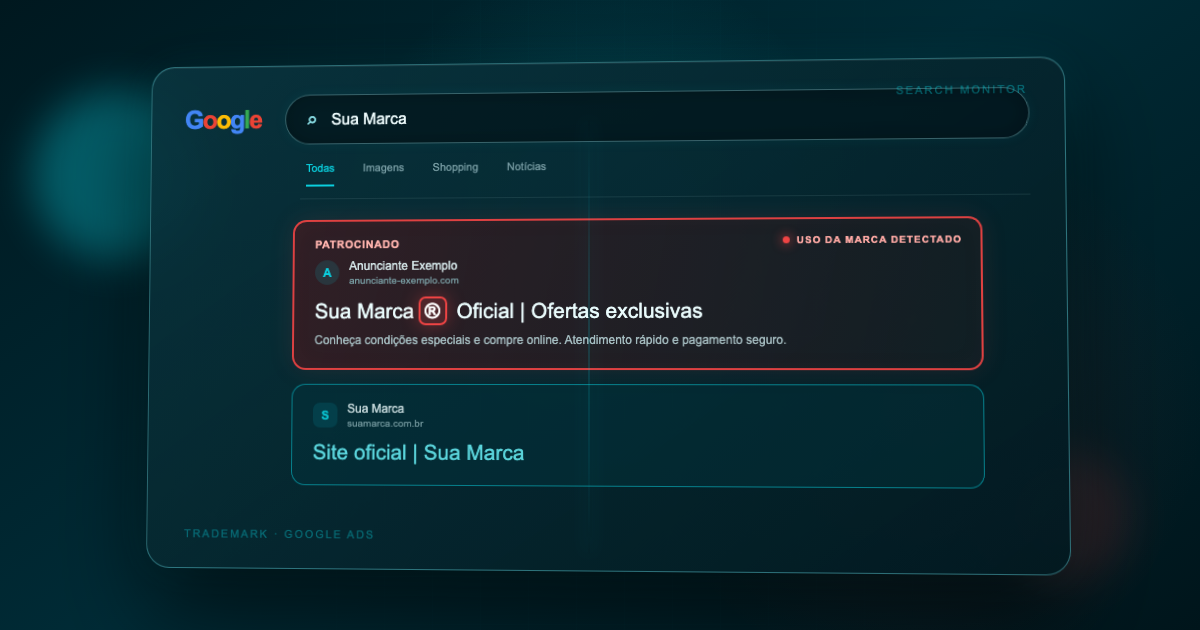
Google Ads trademark policy addresses trademark use in ads, but it does not create a blanket block on brand keywords. To assess an incident, separate the search query, the advertisement and its destination. Preserve evidence and check the applicable policy before requesting a restriction from the platform.
What should you separate before assessing an incident?
Searching for your company name may display another organization's advertisement. That is an observable fact; the purchased keyword, campaign configuration and advertiser's intent may still be unknown. Do not turn a screenshot into a claim about account information your team cannot access. Label the observation and the uncertainty separately.
In this context, “trademark” commonly refers to the platform's process for reviewing trademark use. It is not trademark registration, a court ruling or automatic protection of every search. Whether particular conduct is lawful requires its own legal assessment. This article focuses on organizing an operational review under advertising policy.
Record three separate objects: the query, the advertisement and the destination page. Our guide to finding who advertises on your brand name covers identification; this article addresses what the evidence supports for a review. The cover is an illustration, not a record of an actual complaint or outcome.
How can you read the policy without promising a complete block?
The policy reviewed does not restrict trademarks as keywords or in the second-level domain of a display URL. Use within an advertisement can be restricted in certain circumstances. Exceptions, including resellers and informational content, have published conditions. Assessment therefore requires the full context, rather than just a matching brand name.
The displayed domain and the final destination are different fields. Preserve both without “correcting” one to match the other. Read the current section on the scope of restrictions before extending a decision to other advertisements, domains or territories. An isolated screenshot does not establish the entire reach of a measure.
The following table is a case preparation tool. It does not reproduce mandatory form fields or replace the platform's assessment.
- Observed layer — What to preserve — Review question
- Search — Exact query, date, location and device — What was actually searched?
- Advertisement — Complete text and contextual screenshot — Which passage prompted the review?
- Identification — Displayed name and advertiser reference — Was the identity confirmed or merely displayed?
- Navigation — Display URL, destination and observed redirects — Do the pages belong to the same incident?
- Commercial relationship — Available authorization or partnership records — Is there information that changes the interpretation?
What evidence helps prepare a consistent request?
Build an incident file with a stable internal identifier. Keep the original screenshot and a working copy for annotations. If you highlight a phrase, also retain the unmarked version. Another reviewer should be able to examine the context without relying on the interpretation of whoever first found the advertisement.
Include the observation date and time zone, the query used, the URL associated with the advertiser and the destination accessed when safe navigation is possible. Distinguish an address copied from the screen from a redirect actually observed. If the destination failed to load, record the failure instead of completing the route by assumption.
Gather ownership and representation documents the organization can legitimately use. Check who holds the right, who will submit the request, the territory involved and whether authorization remains current. This is a preparation checklist, not a mandatory attachment list. Actual requirements must be checked through the official channel when completing the request.
To reduce rework, ask a second reviewer to locate the disputed passage, supporting evidence and explanation without an oral briefing. Remove statements that cannot be connected to a file or source. Avoid unnecessary personal information and keep sensitive documentation within the organization's appropriate access controls. Record missing evidence as missing, without replacing it with a confident description.
Which official route should you use and verify?
Google's content reporting troubleshooter lets users select a product and a basis for reporting. During our editorial review on October 22, 2026, the search advertisement trademark route led to a form requiring email verification before subsequent steps appeared. We did not submit a complaint or verify fields behind that step.
An authorized submitter should follow the current flow, check that the address is legitimate and review the instructions provided. Do not assume an old screenshot of the form is still accurate. Separate documents prepared internally from documents actually requested, and retain the final version submitted by the responsible person.
Also distinguish policy and legal reporting channels. Google's troubleshooter explains that reporting through one route does not automatically replace the other. Choose a basis that fits the facts. Do not choose a category merely because it appears more likely to generate a quick response or offers a familiar form.
How should you handle identity confusion and uncertain relationships?
A commercial reference needs to be assessed in the context of the offer. Before classifying an incident, check the relationship between the organizations and record what remains unconfirmed. An outdated internal partner list can lead to the wrong conclusion. Review must allow for authorization or circumstances that do not support the intended request.
If the observed problem concerns false identity or affiliation, also examine the misrepresentation policy. This is a separate basis with its own criteria. Do not turn every trademark dispute into a fraud allegation. Describe the concrete element that raised concern and state the limits of the information currently available.
Consider an entirely fictional example: a team finds an advertisement but has not established whether the advertised business belongs to its reseller network. The appropriate status is “commercial relationship awaiting confirmation.” The team can preserve the evidence while checking authorization. That record is more useful than declaring a confirmed violation and later losing the correction history.
How can you track a response without confusing submission with results?
Use separate stages: preparation, internal review, submitted, response received, further information requested and decision recorded. Keep a reference number when provided and retain the original correspondence. A receipt proves submission, not a restriction. An advertisement's absence from a later search does not, on its own, demonstrate a favorable decision.
When a response arrives, connect it to the exact case. Record which URLs and evidence were considered, the explanation provided and any remaining questions. If a request is denied, review the reason before submitting again. Our article on reviewing a denied removal request provides a complementary process for that stage.
Do not count three screenshots of the same advertisement as three completed measures. Separate incidents, requests and decisions in reporting. When content is observed again, preserve its date and relationship to earlier records without deleting prior evidence. Do not attribute a reduction in media costs to this process without a separate, comparable measurement.
A useful handover records the current owner, the next action and the evidence needed to complete it. Avoid a status such as “in progress” without a specific dependency. A pending reply and an internal documentation gap require different work, even if neither case has reached a final decision.
Where can Branddi support the operation?
Branddi's public Brand Bidding FAQ describes monitoring configured to an agreed scope and incident records containing source, date, context and evidence. This organization can support triage across media, brand protection and legal teams. The contracted scope should specify coverage, responsibilities, access to records and how responses will be followed up.
When considering external support, use these brand protection provider selection criteria. If your initial question is who should lead the work, also read who to hire when competitors advertise on your brand. No provider should turn a request into a promise about the platform's decision.
What questions commonly arise during review?
Does one complaint automatically cover every competitor?
Do not assume that scope. Connect each case to its evidence and response. Before reporting broader coverage, check the decision and the conditions applicable to that specific request.
Should I send documents that have not been requested?
Prepare relevant documentation, but check the current flow before transmitting files. Building an internal case file and meeting the actual form requirements are separate steps with different purposes.
Does a disappearing advertisement prove the request worked?
No. Record the observed absence and the search conditions. To report that a decision occurred, retain the corresponding communication and distinguish that fact from a subsequent search result.
Does Branddi guarantee that the platform will accept a complaint?
The platform makes the decision. Assess the work through evidence quality, suitability of the stated basis and traceable follow-up, without promises of acceptance or a removal deadline.
Which sources support this update?
Primary sources reviewed on October 22, 2026:
- Google Ads trademark policy: https://support.google.com/adspolicy/answer/6118?hl=en
- Google Ads misrepresentation policy: https://support.google.com/adspolicy/answer/6020955?hl=en
- Google content reporting troubleshooter: https://support.google.com/legal/troubleshooter/1114905
- Branddi Brand Bidding FAQ: https://branddi.com/pt-br/solucoes/brand-bidding
To organize incident assessment and evidence-based follow-up, explore Branddi's Brand Bidding solution and define the scope your brand needs.
Related articles
-
Competitors advertise on my brand: who should I hire?
Learn who to hire for brand bidding monitoring, what evidence to request and how to assign responsibilities across media, legal and brand protection.
-
From AI Recommendations to Google: The New Brand Bidding Risk
Discovery is moving to AI, but validation still happens on Google. Learn why defending branded terms and measuring AI Search now belong to one operation.
-
How to find who advertises on your brand name
Identify ads appearing on searches for your brand. Use an evidence template, check the advertiser and understand the limits of keyword inference.
-
What brand bidding is and why it raises your brand CPC
Brand bidding means buying your brand name as a keyword. See the auction mechanism that raises your CPC, what Google allows and what Brazilian courts ruled.
-
85% of Conversions Come from Branded Terms: Why Protecting Your Brand Terms Is the Most Profitable Decision of 2026
Branded terms concentrate 85% of conversions in Google Ads. Learn how to protect your brand terms against brand bidding and maximize ROI in 2026.