Brand Bidding
From AI Recommendations to Google: The New Brand Bidding Risk
Branddi · Published on
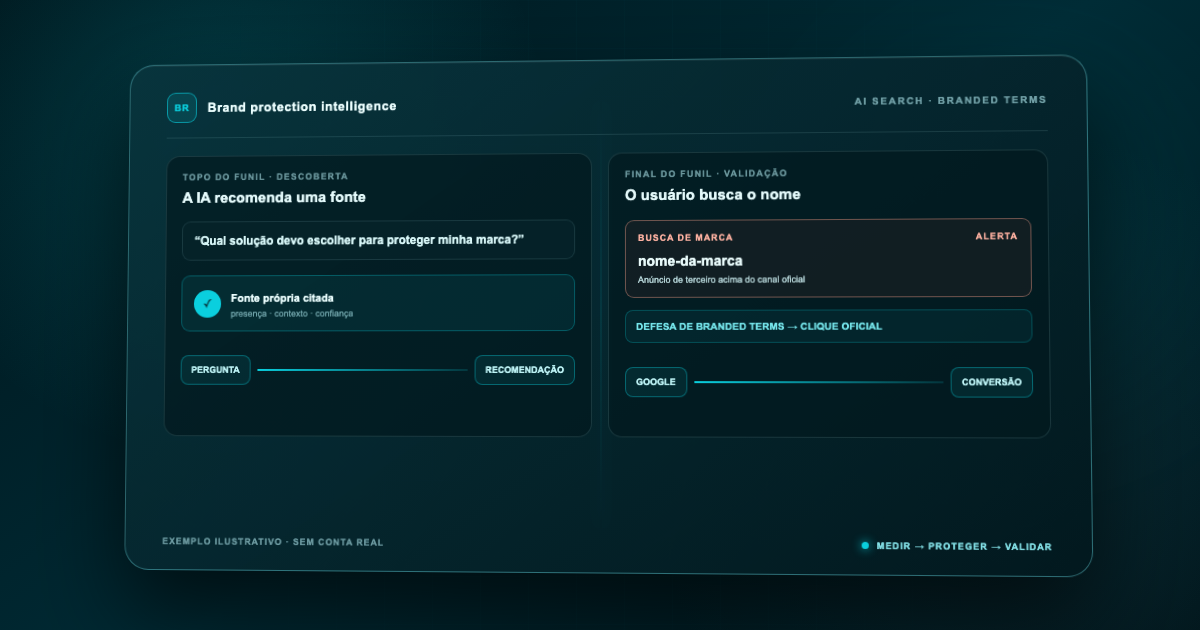
From an AI recommendation to a Google search, discovery now happens in two connected moments. At the top of the funnel, informational questions are answered by ChatGPT, Gemini, Perplexity, and Google’s AI features. At the bottom, people search the brand name to validate a choice. Protecting visibility in AI and defending branded terms prevents that intent from being diverted.
What changed at the top of the funnel?
Organic content used to be the main entry point for questions such as “which solution should I choose?” or “how do I solve this problem?”. That path still exists, but it is no longer the only one.
Generative answers now summarize research, compare alternatives, and cite sources before a click. Pew Research Center found that users clicked a traditional result in 8% of visits when a Google AI Overview appeared, compared with 15% when it did not. The study, published July 22, 2025, is not a forecast for every market, but it shows how direct answers change behavior.
Ahrefs found a similar signal through another method. In an analysis of 300,000 keywords, it estimated that an AI Overview correlated with a 34.5% lower click-through rate for the top-ranking page on informational queries. This is a correlation from a specific dataset, not a universal prediction. It still reinforces that organic position and click are no longer the same thing.
The role of top-of-funnel content therefore expands: it must generate visits, but also provide evidence that AI systems can interpret, cite, and associate with the correct entity. A brand needs to be found, described accurately, and included in the questions that precede a decision.
Does AI discovery replace Google?
No. The journey is distributed. Someone may start in an AI assistant, open a source, check reviews, compare prices, and search the company name on Google. Someone else may see an AI Overview inside Google and then perform a navigational search. The strategic mistake is treating behavior change as a perfectly measurable transfer of every visit.
Google says that AI Overviews and AI Mode are included in Search Console web search traffic. GA4, by contrast, classifies referrals from ChatGPT, Gemini, Perplexity, and other assistants in the AI Assistant channel, while Google’s own AI experiences remain associated with organic search. Without this distinction, teams can double count channels or assume every organic decline became AI referral traffic.
Why are branded terms the last line of defense?
The top of the funnel creates awareness and consideration. The bottom concentrates validation and action. When someone searches a brand name, there is usually already a choice hypothesis: they want the official website, reputation, terms, or a contact path.
That query has a different value from a generic informational search. If a competitor or affiliate appears prominently in an ad, it can capture the click when intent is closest to conversion. The brand may have been recommended by an AI, cited in an article, and recognized by the user, yet lose the visit on its own branded result page.
Brand bidding should therefore be treated as bottom-funnel protection. The goal is not to block every third-party mention or assume every keyword purchase is improper. It is to protect official visibility, detect recurring advertisers, preserve evidence, and distinguish legitimate competition from potentially confusing trademark use.
How can brand bidding capture intent formed outside Google?
Consider this hypothetical journey:
- A person asks an AI which companies solve a problem.
- The AI cites the brand and a first-party or comparison source.
- The person searches the brand name on Google to validate the recommendation.
- A third-party ad appears above the official result and offers a similar alternative.
- The click, conversion, and revenue may be attributed to the advertiser that intercepted the final step.
This example does not prove that AI originated the conversion. It shows why both environments need to be analyzed together. Top-of-funnel protection covers presence, accuracy, and source. Bottom-of-funnel defense covers term coverage, ad quality, position, and traffic diversion.
What should be measured at each stage?
- Stage — Management question — Indicators and source
- Informational discovery — Does the brand appear before the buyer knows which provider to choose? — Non-branded impressions and clicks in Search Console; presence in monitored AI questions
- Recommendation — Does AI describe the brand accurately and cite owned sources? — Presence, cited source, competitors, and first-citation position
- Assistant traffic — Did someone click from an external assistant? — Sessions, key events, and conversions in GA4 by source
- Branded validation — Who captures the brand-name search? — Impressions, CTR, CPC, paid and organic clicks, Auction Insights
- Business outcome — Did protection create commercial value? — Leads, pipeline, revenue, or incremental margin with an explicit attribution model
An AI visibility score is a presence signal, not revenue. An ad impression is not automatically a lost customer. Preserve the chain: visibility, visit, key event, pipeline, and revenue. When a step cannot be evidenced, record the gap instead of filling it with an estimate.
How do you protect the top of the funnel in AI?
Start with real questions that precede purchase. Build a fixed set covering category questions, comparisons, selection criteria, and risk situations. For every answer, record the prompt, date, model, region, brands cited, sources, first-citation position, and screenshot.
Then improve sources that AI can verify: one-question pages, dated first-party data, named authors, complete external references, transparent comparisons, coherent internal linking, and structured data. Google recommends the same foundational SEO practices for AI Overviews and AI Mode: helpful, reliable, crawlable content eligible for a snippet. There is no secret optimization that guarantees a citation.
How do you defend branded terms on Google?
Separate brand campaigns from other campaigns and establish a baseline. Track impression share, losses to budget and rank, CPC, triggering terms, ad copy, final URL, and recurring competitors in Auction Insights.
When an occurrence appears, preserve the full context: query, date, time, country, device, ad, display URL, final URL, and screenshot. Google’s trademark policy distinguishes using a trademark as a keyword from using it in ad text. Buying a competitor’s keyword is not automatically a violation; confusing ad use may require a specific review and reproducible evidence.
Media should measure economic impact. Legal or brand protection should classify risk and select the response channel. The operation works only when every alert arrives with enough evidence for a decision and the result is checked after action.
For more on term defense, read the brand bidding X-ray and what Google Ads trademark protection actually blocks.
How do you connect Search Console, GA4, AI, and Google Ads?
Review four blocks every month: informational queries; AI presence and sources; external assistant sessions and key events; and branded queries, competitor ads, CPC, impression share, and conversions. Use the same window, baseline, and conversion definition. Use UTMs when you control shared links, but do not invent an origin for unattributed visits.
A practical 90-day plan
Days 1–30 — baseline: inventory brand terms, informational queries, campaigns, AI sources, and key events. Fix GA4 classification and document the current state.
Days 31–60 — protection: update high-value top-of-funnel pages, publish owned evidence, and configure brand bidding alerts. Assign owners across media, content, and response.
Days 61–90 — integration: compare AI presence with branded search and conversion. Prioritize cases where AI recommends the brand but the final Google search shows a competitor, or where the brand is cited without an owned source.
The goal is not to prove a perfect migration from organic search to AI. It is to find where the journey changed, which signals are observable, and where the brand loses control. At the top, protection means being found and recommended accurately. At the bottom, it means ensuring a search for the brand reaches the official channel instead of an ad trying to intercept the intent.
Does lower organic traffic prove that people moved to AI?
No. Demand, algorithm changes, seasonality, competition, SERP layout, and measurement can all contribute. Use Search Console, GA4, and AI monitoring to test hypotheses.
Is Google AI Overview AI traffic or organic traffic?
Google includes AI Overviews and AI Mode in organic Search Console traffic. External assistant referrals may appear in GA4’s AI Assistant channel. Keep the definitions separate.
Should every ad using my brand name be blocked?
No. Keyword bidding, nominative use, authorized resale, and confusing use are different situations. Classify the ad, landing page, advertiser relationship, and applicable rule before reporting.
What is the most important metric?
No single metric is enough. Follow the chain from AI presence and branded search to click, key event, pipeline, and attributable revenue or margin.
See also how to measure ChatGPT, Gemini, and Perplexity traffic in GA4 and how AI visibility is measured.
Sources
- https://www.pewresearch.org/short-reads/2025/07/22/google-users-are-less-likely-to-click-on-links-when-an-ai-summary-appears-in-the-results/
- https://ahrefs.com/blog/ai-overviews-reduce-clicks/
- https://developers.google.com/search/docs/appearance/ai-features
- https://support.google.com/analytics/answer/9756891
- https://blog.adobe.com/en/publish/2025/03/17/adobe-analytics-traffic-to-us-retail-websites-from-generative-ai-sources-jumps-1200-percent
Related articles
-
Competitors advertise on my brand: who should I hire?
Learn who to hire for brand bidding monitoring, what evidence to request and how to assign responsibilities across media, legal and brand protection.
-
Google Ads Trademarks: What They Actually Restrict
Learn what Google Ads trademark policy restricts, what remains permitted, and how to prepare a complaint without confusing trademarks with brand bidding.
-
Affiliate brand bidding: program rules and evidence
Set rules and exceptions for affiliates advertising on your brand. Check relationships, evidence and corrections before deciding on commissions or sanctions.
-
How to find who advertises on your brand name
Identify ads appearing on searches for your brand. Use an evidence template, check the advertiser and understand the limits of keyword inference.
-
What brand bidding is and why it raises your brand CPC
Brand bidding means buying your brand name as a keyword. See the auction mechanism that raises your CPC, what Google allows and what Brazilian courts ruled.