Brand Bidding
Competitors advertise on my brand: who should I hire?
Branddi · Published on
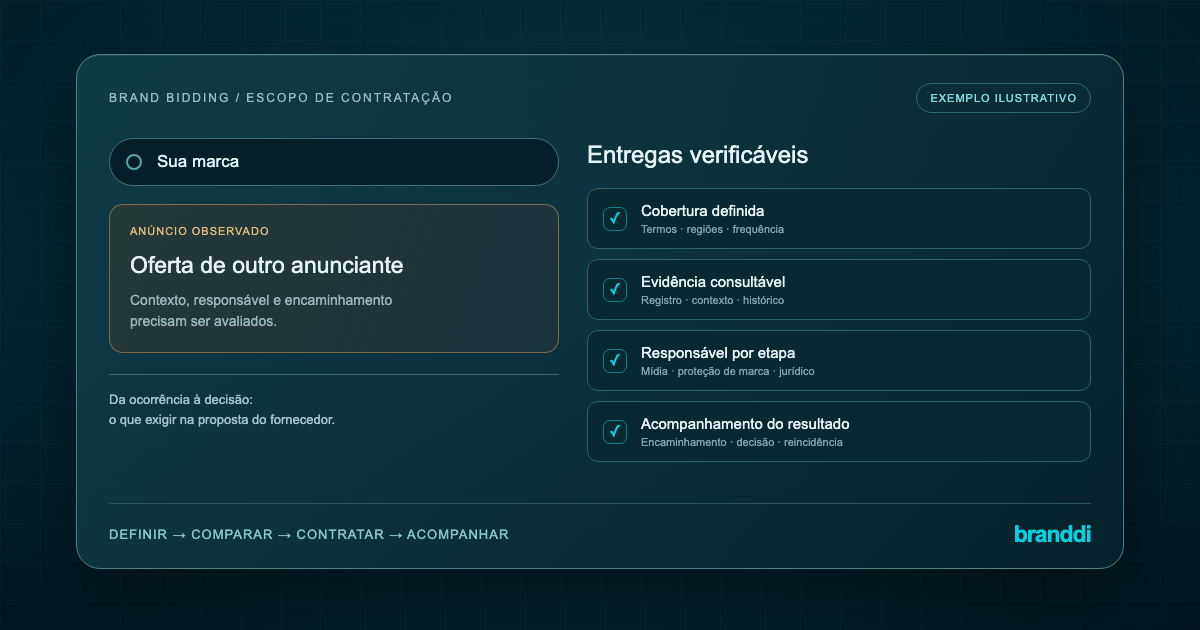
If competitors run Google ads using your store's name, look for a brand protection provider that offers brand bidding monitoring. Coordinate that service with your media agency and, when needed, legal counsel. Your agreement should specify evidence, responsibilities, escalation procedures and follow-up, so you can assess what the provider actually delivers.
Finding an ad is the start of a purchasing decision. Before requesting a quote, decide whether you need to investigate one incident, track recurring ads or coordinate action on specific uses of your trademark. That choice determines the service, coverage and deliverables you should put in the agreement.
Who should handle each part of the problem?
Assign each participant a task you can verify. A media agency can assess your campaigns; a brand protection provider can organize monitoring and evidence; legal counsel can assess rights and legal options. Confirm each provider's scope, because these responsibilities do not automatically come in the same package.
- Need — Team or provider to involve — Deliverable to request
- Understand the effect on your campaigns — Media agency or in-house team — Analysis of the period, monitored terms and campaign changes
- Track recurring third-party ads — Brand protection operation — Defined coverage, records and a searchable history
- Assess trademark use and legal options — Legal counsel — Case assessment, required documents and recommended next steps
- Address an affiliate or partner incident — Program manager and contracted provider — Authorization check and a record of the response
- Submit a platform complaint — Rights holder or authorized representative — Evidence, reasoning, submission record and follow-up
Appoint someone within your company to coordinate these responsibilities. Otherwise, a report may reach the agency while the necessary authorization sits with another team. The proposal should explain who receives each incident, who decides what to do and how unresolved tasks are escalated.
What should you define before requesting a proposal?
Prepare a scope request, not just a list of competitors. Provide the brand name, relevant variations, markets and official domains. Identify authorized partners and situations that need review. This reference helps distinguish legitimate resellers from accounts falsely claiming to be your official business.
If you still need to find and document ads, start with the guide to discovering who advertises on your brand name. For procurement, turn those findings into questions about execution:
- Which terms, regions and devices will be monitored?
- How often will checks run, and what limitations apply?
- Who reviews a finding before treating it as actionable?
- Who submits the response, under what authorization and through which channel?
- How will the provider show what happened after submission?
Ask for written answers. Phrases such as “complete monitoring” or “total protection” do not define coverage. A narrower, explicit service is easier to evaluate than a broad promise without a list of terms, locations or responsibilities. Agree how changes to that list will be requested and documented.
What evidence should the provider deliver?
Request an anonymized or demonstration incident record. It should show the query observed, the date, the ad displayed and its destination. Ask the provider to separate observed information from the analyst's interpretation, so your team can review the basis for a proposed action.
Google's official introduction to the Ads Transparency Center, published on March 29, 2023 and accessed on October 16, 2026, describes access to ads, regions and display dates. Ask how the provider uses this resource and what other evidence supports its monitoring.
A list of advertiser names is not a sufficient service demonstration. Follow one incident from capture to review, from review to submission, and from submission to outcome. If a stage has not happened, it should remain marked as pending, with an identified owner. Ask whether your team can retrieve the record later without rebuilding the investigation.
Can a provider guarantee that a competitor will stop advertising?
Do not use that promise as a purchasing criterion. The Google Ads trademark policy, accessed on October 16, 2026, does not restrict trademarks used as keywords. Trademark use in ad copy is subject to the policy's criteria. Platform policy is separate from legal assessment.
The provider should explain the issue it identified and the action it recommends. An ad appearing for a search does not, by itself, establish a violation. For the platform mechanism, see what Google Ads trademark restrictions actually cover.
Separate service response, submission and decision. Google's guidance on reporting an ad, accessed on October 16, 2026, explains that Google reviews reports and acts where appropriate. A submission record confirms that a report was sent; it does not establish that the ad stopped appearing.
How should you compare proposals beyond price?
Give providers the same scope. Compare the same terms, territories and deliverables. Check what the subscription includes and what requires an additional service. A proposal covering alerts alone is different from one covering review and follow-up. Make that distinction visible before negotiating fees or selecting a package.
- Criterion — Question to ask during a demonstration
- Coverage — Where and under which conditions does monitoring run?
- Review — Who distinguishes actionable findings from authorized activity?
- Evidence — Can I inspect an incident's context and history?
- Execution — Who handles each submission, and what does my team need to do?
- Outcome — How are decisions, subsequent observations and repeat incidents recorded?
- Continuity — How do I export the history and end the service?
Use this table alongside the criteria for selecting a brand protection company. Avoid comparing success percentages without knowing which cases were counted, the reporting period and the definition of success. Also ask how unresolved cases appear in the report and whether any categories are excluded from the calculation.
How can you organize a pilot before expanding the contract?
Agree an initial set of terms and a monitoring period that suits your operation. Record the scope before starting. Then assess whether the provider delivered what was agreed: documented checks, reviewed findings, assigned responsibilities and tracked outcomes. A useful pilot tests the working process as well as the report presented at the end.
Consider an illustrative example: a store monitors its brand and one commercial variation in two regions. The pilot identifies a competitor and an authorized partner. The test should show whether the service distinguishes those contexts and routes each case to the right owner. This is not a Branddi customer story, a measured result or a performance promise.
At the end, review the gaps. An ad that is no longer observed may have been paused, retargeted or absent from that particular check. The evidence must state what was actually verified. Do not treat absence from one search as proof that the issue has been permanently resolved.
How can Branddi support this operation?
Branddi's Brand Bidding solution monitors searches and ads related to the brand, records incidents and organizes evidence. Its agreed scope can include terms, query variations, advertisers, ad copy and destination URLs. The findings support assessment and prioritization of the appropriate next steps.
Bring your observed situation to the commercial discussion and request a demonstration relevant to your objective. Confirm coverage, frequency, responsibilities and deliverables before contracting. The Branddi Brand Bidding solution page, accessed on October 16, 2026, describes the service and provides a way to speak with a specialist.
Which questions should you resolve before signing?
Do I need to replace my media agency?
Not necessarily. Check your existing agreement first. Brand protection can complement the agency if the contract makes clear who assesses campaigns, who monitors third parties and who follows up on submissions.
Will a single complaint resolve recurring incidents?
It may address one episode. A recurring service should include further checks and a history. Define how repeat incidents connect to earlier cases and when the provider will perform a new assessment.
Does the pilot need to prove a lower CPC?
The pilot should demonstrate the agreed deliverables. CPC and conversions require separate analysis, including campaign context and changes during the period. Do not attribute a financial movement solely to the number of ads addressed.
How do I avoid paying for duplicate services?
Compare responsibilities in existing agreements with the new proposal. Remove duplication and define handoffs between teams. Purchase a service for an identified need, with evidence of execution and an owner for each stage's outcome.
To define the scope for your business, talk to Branddi about Brand Bidding.
Related articles
-
From AI Recommendations to Google: The New Brand Bidding Risk
Discovery is moving to AI, but validation still happens on Google. Learn why defending branded terms and measuring AI Search now belong to one operation.
-
Google Ads Trademarks: What They Actually Restrict
Learn what Google Ads trademark policy restricts, what remains permitted, and how to prepare a complaint without confusing trademarks with brand bidding.
-
How to find who advertises on your brand name
Learn how to identify Google ads on your brand name, capture evidence, check transparency and decide when to report them.
-
What brand bidding is and why it raises your brand CPC
Brand bidding means buying your brand name as a keyword. See the auction mechanism that raises your CPC, what Google allows and what Brazilian courts ruled.
-
85% of Conversions Come from Branded Terms: Why Protecting Your Brand Terms Is the Most Profitable Decision of 2026
Branded terms concentrate 85% of conversions in Google Ads. Learn how to protect your brand terms against brand bidding and maximize ROI in 2026.