Brand Protection
Phishing against fintechs: choosing brand protection
Branddi · Published on · Updated on
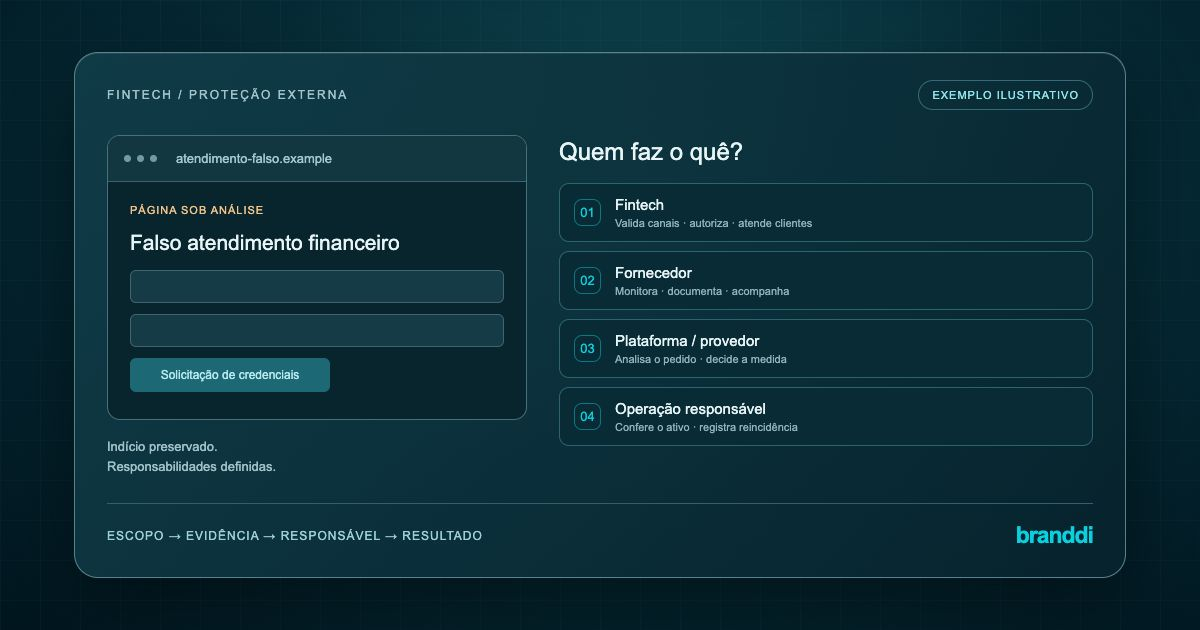
A fintech facing phishing sites that use its name can hire digital brand protection covering external monitoring, documentation and removal request tracking. The scope must define channels, responsibilities and outcome evidence. This service complements internal security and fraud controls; it does not replace account protection or guarantee decisions made by third parties.
This guide helps define work across brand, security, fraud, customer support and the provider. For an introduction to the threat, see the article on phishing and its impact on brands.
What kind of provider monitors phishing using a fintech’s name?
Look for a provider that demonstrates monitoring of external misuse of brand identity and the ability to organize incident handling within the contracted scope. Ask for a demonstration starting with a finding and ending with evidence of the asset’s current state. An alert count alone is insufficient.
Establish whether the offer includes an operated service, software for your team or both. Who validates the finding? Who prepares the report? Who is authorized to represent the fintech? Who answers requests for additional information? These activities need owners before work starts, including when the page remains available.
What should be contracted and what stays with the internal team?
Start with an inventory of official brands, domains, apps, profiles and support channels. Include authorized partners that may appear in search results. The inventory helps distinguish a suspicious copy from a legitimate operation and needs an owner responsible for updates.
Describe the external surfaces to be observed: similar domains, pages imitating login or support, and profiles or ads directing people to those pages. For each surface, specify frequency, territory, language and limitations. “Continuous monitoring” should translate into a routine the buyer can verify.
Keep internal responsibility explicit for authentication, sessions, potentially compromised accounts and transaction analysis. A brand protection service should not automatically be treated as a security operations center, or SOC, or as a complete incident response service.
NIST SP 800-61 Rev. 3, published in April 2025, integrates incident response into cybersecurity risk management: https://csrc.nist.gov/pubs/sp/800/61/r3/final, accessed November 10, 2026. The practical implication here is to organize handoffs between teams without placing every responsibility inside a removal contract.
How can the scope become a responsibility matrix?
Use the matrix below as a starting point for discussions. It is an editorial operating proposal, not a description of contracted Branddi features.
- Channel — Indicator — Evidence — Owner to assign — Outcome tracked
- External page — Login presented as official — URL, capture and comparison — Provider and fintech security — Infrastructure report and page status
- Domain — Name linked to observed fraud — Registration and technical context — Technical analyst and registrar — Decision concerning the domain
- Social profile — Fake support directs users to a site — Profile, content and link — Authorized operation and platform — Decision per account or post
- Ad — Offer leads to a suspicious page — Identifier and observed destination — Authorized operation and platform — Separate action on ad and destination
- Internal support — Customer reports exposure — Restricted report and case reference — Support, fraud and security — Guidance and internal investigation
A provider can prepare and track a request without controlling every recipient’s decision. Identify the host, registrar or platform according to the asset. ICANN’s program defines its DNS abuse remit: https://www.icann.org/dnsabuse, updated July 2026 and accessed November 10, 2026.
How should evidence and removal requests be tracked?
Require a unique incident reference, source, date, description and history. The record should connect the observed asset to the submitted request and subsequent check. A recipient needs to understand the issue without receiving victim information that is unnecessary for that task.
CERT.br recommends choosing notification contacts according to the incident: https://www2.cert.br/docs/notificacoes/, version dated November 14, 2025, accessed November 10, 2026. For steps concerning a specific address, use the fake website reporting and removal guide.
Agree how attachments will be shared, who can access them and how they will be returned or deleted when the contract ends. Do not include passwords, authentication codes, identity documents or full account statements in demonstrations. Real reports should follow internal access controls and data minimization rules.
How can three tabletop tests support pilot acceptance?
The protocol below is an editorial proposal using three entirely fictional scenarios. It describes no customers, attacks or Branddi performance. Use simulated records and screenshots, without public pages, credentials, personal information or real reports. The purpose is to check decisions and responsibility handoffs before purchasing the operation.
Before the session, the fintech and provider should record scope, primary and backup owners, acceptance criteria and available documents. A facilitator supplies the records; a reviewer follows the history without guiding the answers. Participants must use the information provided and record gaps rather than assume authorization.
Test 1: does the process recognize a legitimate channel?
Simulated input: a support screenshot uses the brand on a partner domain. The inventory supplied to the internal owner confirms that partner and the channel's purpose. The analyst initially receives only the screenshot, to demonstrate how confirmation is obtained.
Expected handoffs: the provider records the finding and consults the inventory owner; that owner confirms authorization and its source; the analyst classifies the case as a legitimate channel in the context examined. The reviewer checks that no removal request was sent and that this decision did not create a permanent exclusion for an entire domain.
Acceptance evidence: a record linked to internal confirmation, the classification rationale, owner and date. Fail this stage if the operation prepares a submission without checking legitimacy or treats initial absence from the inventory as proof of fraud. Correct the rule and repeat the scenario before allowing external action.
Test 2: does an impersonating page receive the right approvals?
Simulated input: a record presents a fictional page claiming to be official and requesting credentials. The reference inventory and internal confirmation establish that it is unauthorized. The facilitator supplies simulated technical evidence about the responsible service; nobody visits a malicious page.
Expected handoffs: the provider documents the false association; security assesses the finding; the authorized representative approves the referral; the analyst prepares the request for review without submitting it. Support and security receive a separate record of possible customer exposure, without waiting for external removal.
The facilitator adds a fictional request for more information and then a screenshot showing unavailability. The analyst should retain the pending case with an owner, incorporate the additional information and record unavailability as a simulated observation. That screenshot cannot become a real removal or an outcome caused by the provider.
Acceptance evidence: a chain connecting finding, validation, authorization, justified recipient, additional information and verification. Fail the stage if authorization is missing, the recipient lacks justification or acknowledgment is marked as removal. The reviewer must be able to resume each step using the history.
Test 3: does an unconfirmed report remain under follow-up?
Simulated input: support receives an incomplete report without an address sufficient to identify the page. The package contains no proof of impersonation or credential exposure.
Expected handoffs: support provides guidance through an official channel and requests only necessary information, never passwords, codes or another interaction with the suspected actor. Security receives the possible exposure for assessment under its internal process. The provider keeps the external asset unconfirmed, names the person who will obtain the missing information and records when the pending case will be reviewed.
Acceptance evidence: separation between report and fact, an explicit gap, an owner and a next review. Fail the stage if the case is declared safe for lack of evidence, closed as a removal or reported externally without an identified asset. A missing URL is not grounds to abandon support for the person.
How should the acceptance decision be recorded?
- Scenario — Required evidence — Reviewer — Possible decision
- Legitimate channel — Authorization checked and action stopped — Channel owner — Accept triage or repeat after correction
- Impersonating page — History and approvals linked to simulated request — Security and authorized representative — Accept the workflow or require correction
- Incomplete report — Gap, owner and next review — Support and security — Accept follow-up or repeat
For each stage, record the observed result, evidence, deviation, correction and retest owner. Approve the procedure only when the essential handoffs are demonstrated. Good results in other scenarios cannot offset an improper report. Tabletop approval demonstrates workflow organization; monitoring coverage and removal performance require their own observations during an authorized operation.
How should recurrence and coverage limits be assessed?
Track unique assets and retain links between related incidents. A removed page may be replaced at another address. Record what supports the association without claiming that two sites share an operator solely because they look similar.
The pilot report should show cases received, validated, submitted and verified, plus those still open. Separate channels and periods. For timing and denominator interpretation, see the guide to takedown stages and timing.
An absence of findings means only that nothing was found under the observed conditions. Record limitations such as restricted content, destination changes or surfaces outside the contract. For the broader purchasing assessment, see how to choose a brand protection provider.
Which questions should be resolved before contracting?
Who can monitor and request removal of these pages?
A brand protection operation with appropriate coverage and authorization can organize this work. Confirm who performs each stage and which recipients will be contacted. The final decision may depend on the infrastructure or platform involved.
Will the provider also block transactions and recover accounts?
Do not assume so. Those are separate activities requiring their own scope and access. The fintech should retain security, fraud and customer support owners even when external asset handling is contracted to another organization.
What removal deadline should be required?
Separate the provider’s response and execution commitments from external review times. Require traceability and comparable channel-level data. Do not turn an observed time into a universal removal promise or treat an acknowledgment as a completed result.
Can Branddi participate in the evaluation?
Branddi describes monitoring within an agreed scope and support for documentation and removal workflows. Bring your channels and incidents to the discussion to confirm applicable coverage. See Branddi digital fraud protection, accessed November 10, 2026.
Related articles
-
In-house or outsourced brand protection: how to compare
Compare internal and outsourced brand protection using tasks, hours, total costs and responsibilities, without assuming prices or outcomes.
-
How the Amazon Buy Box works and why you lose it
The Buy Box concentrates sales on the product page. See Amazon's and Mercado Libre's official criteria, and what changes with the 2026 eligibility removal.
-
How to choose a brand protection company: 9 criteria
Compare brand protection companies using nine criteria and a completed fictional proposal exercise, with disqualifying gaps and a justified decision.
-
TikTok Shop, YouTube Shop, and ChatGPT Shop: The New Battlefields of Brand Protection in 2026
TikTok Shop, YouTube Shopping, and ChatGPT Shop have become new sales channels — and new risks. See how to protect your brand in social commerce in 2026.
-
Buy Box Under Attack: How Hijackers and Price Wars Are Crushing Your Margin on Marketplaces
Hijackers, repricing bots, and lack of MSRP are destroying brands' Buy Box and margin on marketplaces. See how to shield your operation.