
Scam marketing is the misappropriation of your credibility, materialized in misleading advertisements, websites, and fake profiles that exploit the trust you've worked so hard to build.
In other words, every scam applied in your name is not just a fraud, but a direct attack on your most valuable asset: your brand's reputation.
At Branddi, we understand this threat in its entirety. After all, dealing with marketing scams is our specialty, and we know exactly how they can dilute your market value and undermine the trust of your customers.
We invite you to continue reading to discover how this tactic works and what are the effective actions to protect your business.
What can we understand by scam marketing?

In a direct way, scam marketing is the use of digital marketing tactics for fraudulent purposes. Thus, it hijacks the identity and credibility of a legitimate brand to carry out scams, create false promotions, and divert customers through channels that seem official, such as advertisements, websites, and social media profiles.
In other words, it is not an isolated threat, but an industry in full expansion. To get an idea of the dimension, a study of Juniper Research points out that the global digital fraud market, including scam marketing, generated losses of approximately $40 billion dollars in 2023 alone.
But what drove this popularization? The answer lies in the democratization of technology. Artificial intelligence and automation tools, which allow mass content creation, empowered fraudsters.
In this way, today, they can generate hundreds of fake sites, convincing advertisements, and social media profiles in an automated way, with a scale and sophistication that make manual defense practically impossible.
And the preferred target of scam marketing are precisely reputable brands. After all, it's your credibility that the fraudster “borrows” to lend an air of legitimacy to the scam.
Remember: the stronger and more reliable your brand is, the more attractive it becomes to these practices. And understanding this is the first step in creating an effective protective barrier!
What are the main types of scam marketing?
To continue conceptualizing the problem, it is worth highlighting: scam marketing is not a single tactic, but an ecosystem of fraudulent strategies that adapt to exploit different vulnerabilities.
Knowing the main modalities is essential to identify attacks against your brand and understand the extent of the risk.
Below, we detail the most common ways that fraudsters use to appropriate your market value.
Phishing

Phishing is perhaps the oldest and most effective impersonation tactic. It consists of sending fraudulent communications, mainly by e-mail, that appear to come from a trustworthy source - such as your brand.
The purpose is to trick the recipient into clicking on a malicious link or providing information.
In the context of scam marketing, phishing uses your brand as bait. A report from Check Point Software warns that 90% of attacks on companies start with a phishing email, and global brands like Microsoft are the most imitated targets.
When a customer receives a fake email from “Your Brand” asking them to update a registration or confirm a purchase, the trust placed in you is used against them. In other words, the damage goes beyond the individual: your brand becomes the face of fraud.
False promotions and sweepstakes
This modality exploits a powerful trigger: the opportunity for good business. Fraudsters create ads and profiles on social networks advertising irresistible offers, such as "90% off” or “Buy 1 Get 2", using your brand logo and images.
These campaigns are designed to create a sense of urgency, prompting clients to act on impulse.
Upon clicking, they are directed to fake pages that may capture data or simply not deliver any product.
The result is customer frustration, the devaluation of their pricing strategy, and a trail of complaints associated with their name.
Fake products and services
A step beyond false promotion, here scammers create e-commerce and entire catalogs to sell products that don't exist, are counterfeit or of much lower quality.
To do this, they copy the design of your site, the descriptions of your products, and use your visual identity to give an air of legitimacy to the operation.
Thus, each sale made through these sites represents a direct revenue lost to you. Even worse, the customer who receives a Counterfeit product (or you don't get anything) associates the terrible experience with your brand, generating negative reviews and a crisis of trust that can be difficult to reverse.
Clickbait and misleading advertising
Clickbait is the art of creating sensational titles and advertisements for the sole purpose of generating clicks. In scam marketing, your brand name is used as bait in headlines like “The Secret [Your Brand] Doesn't Want You to Know” or “Leaked! New line from [Your Brand] with 80% discount”.
These links are the gateway to more complex fraud. While clickbait seems harmless, it takes the user to the epicenter of the fraud, whether it's a phishing page or a fake store.
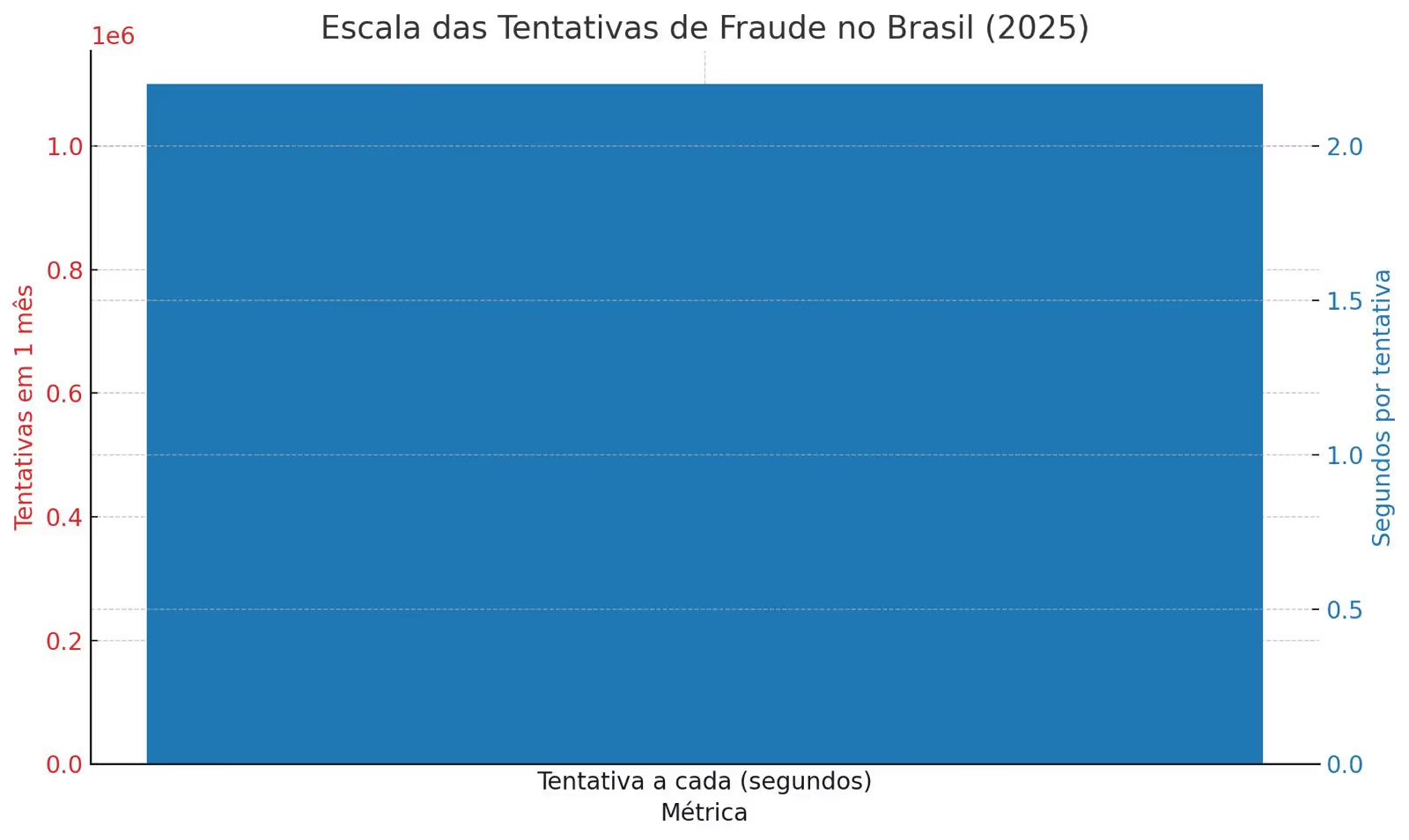
The scale of this threat in Brazil is alarming. According to the indicator of Serasa Experian, the country registered more than 1.1 million fraud attempts in a single month in 2025, equivalent to one attempt every 2.2 seconds.
Every click on a misleading ad contributes to that statistic, eroding your brand's credibility in the process.
Fake reviews and testimonials
To give credibility to their fraudulent pages and offers, scammers often fabricate dozens of positive reviews and testimonials. To do this, they create a false perception of “social proof”, making the fraud appear to be a legitimate and trustworthy business.
This tactic deceives the consumer and creates unfair competition with your true offer.
So, while you invest to build an authentic reputation, the fraudster simulates it with a few clicks, making the digital environment more confusing and undermining public trust in online reviews.
Fake Domains (Scam Domains)
Fake domains are the core infrastructure of nearly every scam marketing. These are website addresses that mimic the official domain of a brand, generally with minor variations (e.g., youramarca-offerta.com or promocaosuamarca.net).
The effectiveness of this tactic is detailed in the 1st Quarter 2025 Phishing Report of KnowBe4.
The study reveals that fraudsters create landing pages that impersonate trusted global brands to steal credentials, with Microsoft, LinkedIn, and Google being the three most successfully imitated.
The report also highlights that 68.6% of the phishing attacks analyzed involved domain spoofing.

In practice, this means that a fraudster can use your name in an email to take the customer to a fake Google page, for example, using your credibility to execute the scam.
Remember: each fake domain is a digital trap that confuses customers and unduly capitalizes on your brand.
How do scam marketing actions impact brands?
The true cost of scam marketing is not in the isolated fraud, but in the domino effect it causes on the entire business. That's because the consequences unfold in a cascade of damages, often silent, that undermine your reputation, your revenue, and your position in the market.
Below, we detail the strategic losses your brand faces.
Damage to reputation
When a customer is misled by a fraud using their name, the negative association is immediate. In other words, your brand, once synonymous with quality, is now linked to blows and frustrations.
This erosion of trust is cumulative. Every fake ad or dubious profile tarnishes your public image, turning your most valuable asset — reputation — into a source of distrust.
Reversing this damage is a slow and costly process that affects long-term market perception.
Loss of customers and loyalty
Distrust is the direct consequence of scam marketing. After all, a customer who is deceived or who simply feels insecure doesn't buy again.
Remember: if the consumer is unable to distinguish their official channel from a scam, loyalty is broken. It stops interacting and seeks safer alternatives, resulting in the loss of valuable customers.
Direct financial impacts
The losses are immediate and measurable. First, there is the direct loss of revenue, with sales being diverted to fake sites or competitors that practice brand bidding. In addition, your marketing costs increase.
Additionally, unfair competition on sponsored links inflates your Cost Per Click (CPC), forcing you to pay more to reach your own audience. You spend more for less return, while fraudsters profit from your investment in brand building.
Increase in operating costs
Fraud overwhelms your internal teams. As a result, the customer service team is flooded with complaints from scam victims, consuming time and resources to manage a crisis that your company didn't create.
Thus, their legal and marketing teams are forced to divert their focus from strategic activities to a reactive hunt for fake profiles and sites.
This effort to “put out fires” represents a hidden but significant operating cost that drains the efficiency of your business.
Loss of competitive advantage
As you fight fraud, your competitors move forward. In other words, its competitive advantage, built on innovation and quality, is overshadowed by the perception of risk. Thus, the consumer, when seeking security, migrates to more reliable alternatives.
By losing that trust, you not only lose customers, but also your ability to differentiate yourself and justify your value in the market.
How to prevent scam marketing actions from affecting your results?
The good news is that you don't have to be a passive victim. Combating scam marketing requires a change of posture: from reactive to proactive.
Effective shielding is not based on isolated actions, but on an intelligent and continuous protection ecosystem.
At Branddi, our experience shows that the most successful brands are those that implement a layered defense.
Below, we present the essential strategies that form the basis of robust brand protection and that ensure that your results are not hijacked by fraudsters.
Perform defensive domain registration
The first line of defense is proactive. Fraudsters need infrastructure to operate, and the main asset of that infrastructure is a domain that looks like yours.
O Defensive record consists of acquiring variations of your main domain before the scammers do so.
This includes common typosquatting (typosquatting), different terminations (.net, .online, .shop), and combinations with keywords such as “offer” or “promo”. So, by controlling these assets, you prevent the creation of convincing fake sites.
Focus on responding quickly to incidents
When fraud is identified, speed of response is everything. Every minute that a fake site or advertisement goes live represents more customers at risk and more damage to your reputation.
Having a rapid incident response plan is critical. This means having clear processes to identify, document, and report violations in an agile and assertive manner.
Remember: quick action not only minimizes losses, but also demonstrates to your customers that you are actively protecting their interests.
Invest in constant monitoring
You can't fight what you don't see, and the digital universe is too vast for manual checks.
Just the constant and automated monitoring, which scans search engines, social networks and marketplaces 24/7, can detect Real-time threats. A critical example is the authentication of emails.
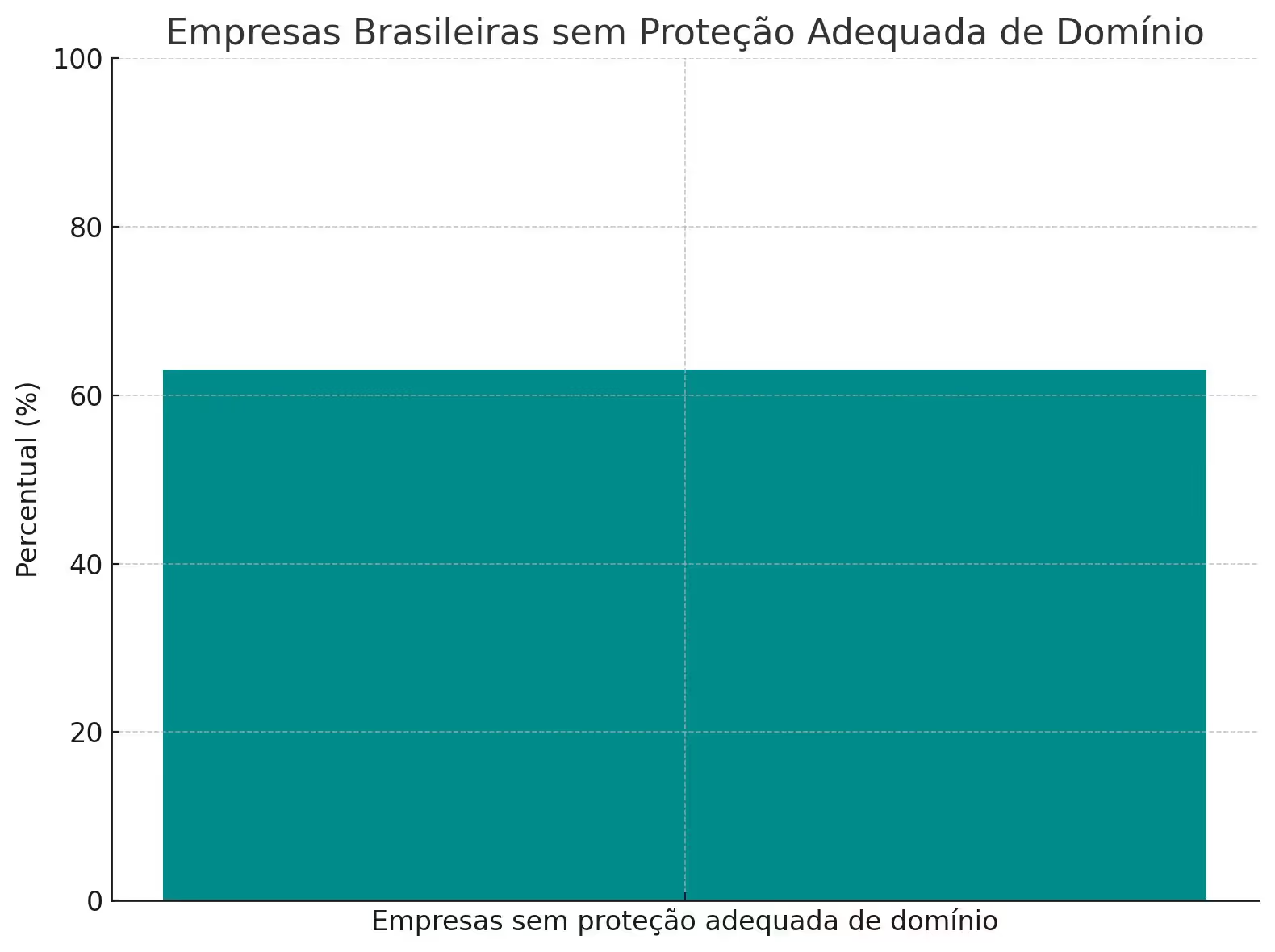
A study by Proofpoint revealed that 63% of the largest Brazilian companies do not adequately protect their domains, putting customers at risk of scams.
This shows that even official channels need technical surveillance so as not to be exploited.
Don't let scam marketing hurt your brand: count on Branddi!
Combating scam marketing alone is a reactive and exhausting battle. For this reason, true protection is proactive and integrated — and this is exactly where Branddi acts as your strategic partner.
We transform complex brand defense into a complete solution, bringing together Artificial Intelligence and dedicated specialists to take care of everything from monitoring to permanent threat removal.
Our results demonstrate the impact of this approach: we have already removed more than 50,000 fraudulent domains and saved R$ 250 million for our clients in advertising costs.
Protecting your greatest asset is a strategic investment in your revenue and reputation, and fighting a technological threat with manual processes is ineffective: you need to have superior technology on your side.
And that's where Branddi comes in: as the ideal solution to protect your business with the right tools. Are you interested? Access our site, talk to one of our online specialists right now and discover our Shielding marketing!



Ready to shield your brand?
Don't let your customers fall into the clutches of competitors, scammers, and exploiters.